In conversation with Stephanie Schorp and Dr Andreas Föller, Gisela Maria Freisinger, a writer for Manager Magazin, explores what makes success. Together, they look back on the success story of an owner-managed executive search boutique and discuss how the understanding of leadership and expectations of top executives have changed over the past 20 years. Read the full interview from Comites’ anniversary magazine here.

The interview
VIDEO INTERVIEW
Bonus material
TESTIMONIALS +
Success stories
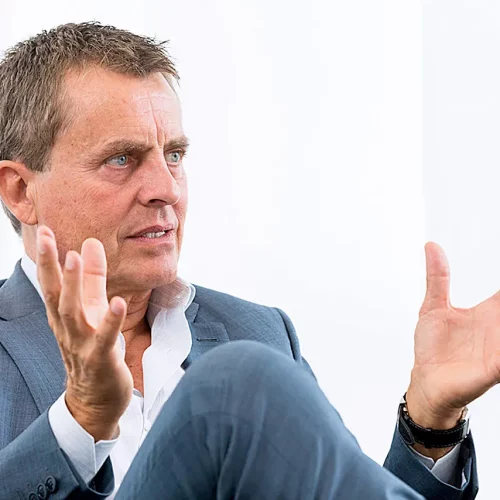
“Turning an entire company upside down with Comites”
Claudio Albrecht is a born CEO. In this role, he turned an entire private equity company on its head in 2010. Comites recruited the headquarters team for him.
Had Claudio Albrecht said no back then, the generics industry would be poorer by one of its best: Having just completed his doctorate in law, he had worked his way up to General Manager at Sandoz USA when Comites called to ask whether he could imagine becoming CEO of Ratiopharm. Albrecht initially declined. But Andreas Föller, with “the gift of the gab”, kept talking to him and ultimately persuaded him—“you really have to say it like that,” Albrecht says. Sometimes it takes not only a calling, but also someone to call you away.
Andreas Föller always believed in Albrecht’s talent—and he was right. When the Tyrolean joined Ratiopharm in October 2000, it was still a Swabian company focused on the German market. Five years later, Albrecht had already made it number three in the international generics market. That was until Adolf Merckle, the company founder, transferred the business to his son overnight—triggering not only the erosion of the Merckle Group, but also a family tragedy. Ratiopharm was sold in 2010. Merckle took his own life. By then, Albrecht was already needed elsewhere. Together with his partner Peter Prock, he founded the strategy consultancy CoMeth in 2007. One day, Deutsche Bank approached them with a request: Albrecht should review the management plan of a generics manufacturer based in Iceland. It was Actavis, which at the time owed the bank €4 billion. Its management plan was wrong—so were those of previous years. Albrecht submitted a version cut by half, stepped in as interim CEO in June 2010 for a company that was already on the verge of being broken up—and just two years later sold it to the US group Watson for a record price of $6 billion. “I think we did a pretty good job,” he says. That is, of course, an understatement.
The industry still talks about the turnaround process Albrecht initiated today. He adjusted the levers of all key processes—research, sales, development, production. He relocated the entire group from Reykjavic to Zug in Switzerland. From the new headquarters, the business press wrote only about the “Orange Power Tower”. Orange because that was the corporate colour, tower because the building was a tower—and power? “Well, I think we worked pretty well as a team,” says Albrecht. For the restructuring, he replaced the entire headquarters team. 250 positions were refilled, with specialists from 35 nations. “And then it took off at full speed.”
How do you recruit so many people so well? Albrecht entrusted the task to Comites. “In the pharma industry, there are probably few who can hold a candle to Andreas Föller,” he says. Comites succeeded in finding 250 people who “not only bring intellectual knowledge, but also emotional commitment, passion”. “And that mix was certainly the secret of success.” Watson bought Actavis partly because of the great people, Albrecht is convinced. He calls it a “huge compliment” that after the acquisition, Watson dropped its own name and renamed itself Acatavis.
After the sale, Albrecht and Peter Prock founded the consultancy “Albrecht, Prock & Partners”. In between, he had to step in again as CEO when, in 2017, he took the ailing STADA private within just one year—pulling off the largest private buyout of a German company of all time. Comites once again handled the refilling of numerous key positions for him. “I know what I owe Andreas Föller,” says Albrecht. And that is a huge compliment for Comites.
Claudio Albrecht (*1959) was born in Tyrol and holds a doctorate in law. From 2000 to 2005, he was CEO of Ratiopharm. Today he works as an independent consultant. www.app-pharma.ch
Photo: Albrecht, Prock & Partners
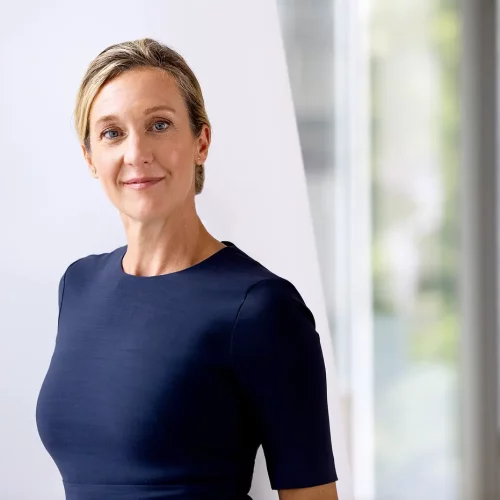
“Looking for talent, found a sparring partner”
Sabine Eckhardt is one of Germany’s Top 100 businesswomen. When it comes to selecting people and as an advisor, she trusts Comites.
Over her 16 years at ProSiebenSat.1 (most recently as a board member), Sabine Eckhardt helped shape the group’s repositioning into a digital media company and had a number of leadership roles filled by Comites. This involved spinning off new GmbHs within the company and “putting your own baby into good hands,” as she puts it. Eckhardt wanted to commission someone who would not only look at professional skills, “but also at the right personality to ensure cultural fit”. At the very first meeting with Stephanie Schorp, she knew: “She’s great. She listens closely and thinks ahead.” Since then, she has experienced the collaboration as “highly valuable”, and Comites as “truly strategic advisory companions”. She is in regular exchange with Stephanie Schorp. Both value each other as sparring partners. “I can always call Stephanie Schorp and ask for her perspective on a wide range of topics,” says Eckhardt. Conversely, Eckhardt has shared her expertise in transformation management as a guest speaker in Comites’ “Mindshift” webinar. There is another side of Stephanie Schorp that she appreciates: “She is a wonderful host! Her events always create encounters with very special personalities.”
Sabine Eckhardt (*1972) serves on multiple supervisory boards at Ceconomy AG, UniCredit Bank AG, Edel SE & Co. KGaA, is a Senior Advisor, and a lecturer at TU Munich on transformation management, innovation and digitalisation.
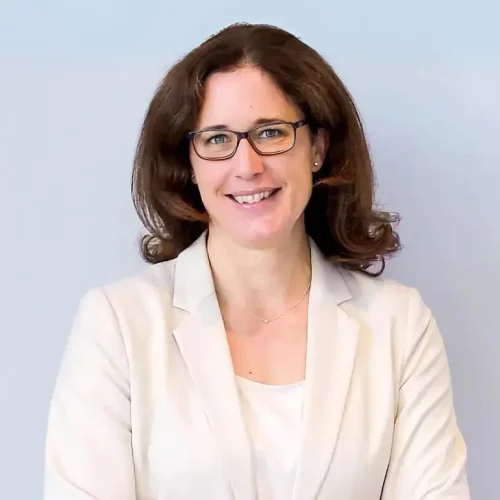
“Now Comites has to step in!”
Martina Seidl moved from Fujitsu to head the Group Legal Department at Giesecke+Devrient via Stephanie Schorp. For tough cases, she knows one address.
“To this day, I am grateful to Stephanie Schorp for convincing me to make a career change. When Comites contacted me at the end of 2018, I had no intention of moving. But Stephanie Schorp advised me extremely well, because she moderated the entire process in such a way that I always had the feeling: it is at least as much about the company and the role fitting me as it is the other way around.
In my new role, we recently failed—neither on our own nor with the help of an external headhunter—to fill a specific leadership position on my team. So, based on my own positive experience, I decided: now Comites has to step in; I trust them to do it. So I called Stephanie Schorp, and she responded brilliantly. She said: Sounds difficult, but we’ll do it. In four weeks, you’ll have candidates from me. And that’s exactly how it happened. I found that phenomenal. This new leader will be joining us later this year.”
Martina Seidl (*1973) most recently served at Fujitsu as Vice President Legal & Commercial and as a supervisory board member of FTS GmbH. Since 2019, she has headed Legal, Integrity & Compliance and Data Protection at Giesecke+Devrient.
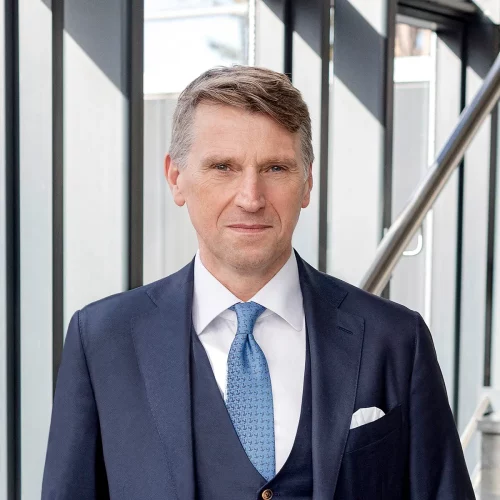
“Comites set my course.”
Twenty years ago, Lothar Harings made the decisive career move: becoming HR board member at T-Mobile. Now he is retiring. A look back at a professional life that only ever went upwards.
Mr Harings, you were one of the first placements in Comites’ history. From Siemens HR manager to T-Mobile board member—how long do you think about it when an offer like that comes calling?
>That was a special constellation even back then. T-Mobile was only just being founded at the time. It was an adventure to join a company that offered a great perspective, but the question was: will it work? Or could it fail?
How did Andreas Föller convince you?
>From the very first moment, it was clear that he was a completely atypical headhunter. You could tell he had done something else in life before. What I still appreciate about him to this day is his very open, unvarnished communication. He made all the risks transparent to me. We met twice in Munich, twice in Bonn, and then the decision was made.
At 42, you suddenly became a board member of a company with 80,000 employees. How does that change your life?
>It is a fundamental change. All of a sudden, you are on a completely different career level and are confronted with entirely different topics. That was not always easy, you can admit that.
Did you get coaching?
>In the past, that wasn’t really a thing; the approach was more: throw them in at the deep end and see if they survive. Not recommended! But I always stayed in touch with Andreas Föller. He gave me tips, also asked around in the company about what people were saying. Over all those years, he was my point of contact. A wonderful friendship grew out of it, too.
You drove T-Mobile forward for seven years. Then you moved to the board at Kühne + Nagel. Andreas Föller describes you as someone who, despite a steep career, always stayed grounded. How did you manage that?
>You know, as an HR board member you see a lot behind the scenes—you see the fates playing out there, especially with people who think they are something better just because they are on the board. You must never forget: it’s just a job, and you can lose it tomorrow. Building your whole personality around it is not a good model for life.
Is family also a balancing weight?
>Absolutely—my wife Marta plays a very big role. She didn’t marry me back then as a board member, but as Lothar Harings. We have three children together. The insignia of power—she couldn’t care less.
After an incredible 14 years, you are now retiring from Kühne + Nagel. Alongside modesty, is perseverance also one of your core virtues?
>Considering that the normal survival time of a board member is between three and four years—then yes. Perhaps it is also a sign that my performance wasn’t entirely bad. Mr Kühne, third generation of the founding family and majority shareholder of the listed company, was surprised when I told him that I was already stopping at 63…
For the first time in twenty years without a board position. So what will you do now?
>Wine will be a topic. Because wine has always been my great passion. I am now making my own wine together with one of Spain’s best winemakers. The first vintage has just been bottled. A Garnacha called “L & M”. For Lothar and Marta. It turned out very well!
From 2002 to 2009, Lothar Harings was HR board member at T-Mobile International, and subsequently Head of HR and a member of the Executive Board at Kühne + Nagel. In summer 2023, he retired.
Photo: Kühne + Nagel